Overview
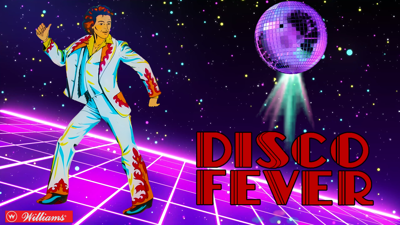
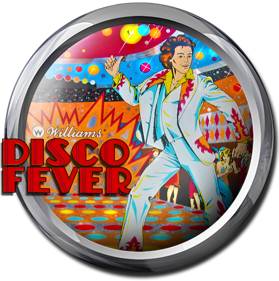
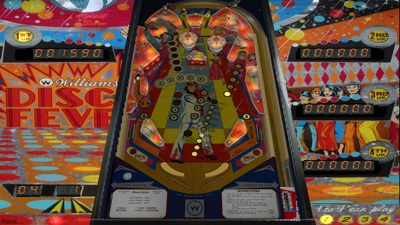
Released in August 1978, Disco Fever was designed by Tony Kramer, and was the fourth solid-state game produced by Williams. It had a production run of 6,006 units. Capitalising on the massive popularity of the 1977 film Saturday Night Fever, the artwork by Christian Marche features an unlicensed resemblance to John Travolta dancing on a light-up floor.
It was the second pinball table to feature electronic sound. Ironically, the machine does not play disco music. It relies on standard early digital sound effects, but it included a unique "2-Way" sound system allowing operators to switch between "Boogie" and "Sci-Fi" chime modes
Instead of standard straight flippers, Disco Fever features curved, hook-like "banana" flippers. They allow players to put unique spin on the ball, but they make aiming highly unpredictable and erratic. Disco Fever and Time Warp are the only two Williams production games to ever use them.
Interestingly, it was the very first pinball machine engineered with speech capability, though only a prototype with voice synthesis was shown at the 1978 AMOA show. The feature was not included in production units and debuted commercially a year later in Gorgar.
- Developers
- Williams Electronic Games
- Publishers
- Williams Electronic Games
- Platform
- Pinball
- Genre
- Pinball
- Alternate Names
- No information available
- Wikipedia
- No information available