Overview
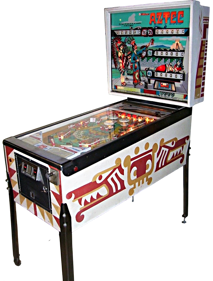
Aztec, released by Williams Electronic Games in February 1976, stands as a landmark title from the twilight of the electro-mechanical pinball era. Designed by Gordon Horlick, this successful four-player machine enjoyed an impressive production run of 10,150 units, making it one of only three Williams EM four-player games to cross the 10,000-unit threshold. The backglass artwork by Christian Marche depicts Aztec figures looking toward a grand Mesoamerican pyramid.
Beyond its commercial success in traditional arcades, Aztec holds a special place in arcade history because Williams utilized it to build a very small run of around ten solid-state (SS) prototypes, marking the company's historic first foray into digital, microprocessor-driven pinball technology. Over half the switches, relays, and solenoids in the electro-mechanical version were able to be removed for this version.
On the playfield, Aztec offers a classic layout that delivers fast, chaotic, and sometimes brutal gameplay. The upper playfield centers around three powerful DC-powered pop bumpers arranged near the peak of an illustrated pyramid, which are known for kicking the ball back at unpredictable angles. The lower playfield utilizes an "Italian bottom" configuration, featuring inward-facing flippers fed by lane guides and flanked by unforgiving outlanes that can easily drain a ball before a player even has a chance to flip. The table relies on an assortment of six standup targets, three rollover lanes, and slingshots to keep momentum high.
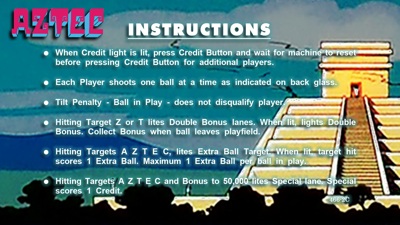
The core ruleset of the game revolves around a spelling mechanic where players attempt to fully light the word "A-Z-T-E-C" by hitting designated targets across the field. Achieving this feat allows players to advance a central bonus ladder up to a massive 100,000 points and qualify for an extra ball or a "Special" replay. The table forces players into high-risk, high-reward situations where they must repeatedly target dangerous areas of the playfield to maximize their score.
Among pinball enthusiasts, Aztec is celebrated for having two of the most satisfying individual shots of its era. The left-hand spinner lane "absolutely rips" when hit cleanly, and lighting the spinner for 1,000 points per rotation serves as a primary strategy for racking up high scores. On the upper right side, a dynamic kickback pocket rewards players with 10,000 points for lit letters while safely ejecting the ball back into play. Accompanied by the nostalgic, tactile chime boxes characteristic of 1970s Williams machines, Aztec remains a beloved, challenging staple for collectors of classic electro-mechanical pinball.
- Developers
- Williams Electronic Games
- Publishers
- Williams Electronic Games
- Platform
- Pinball
- Genre
- Pinball
- Alternate Names
- No information available