Overview
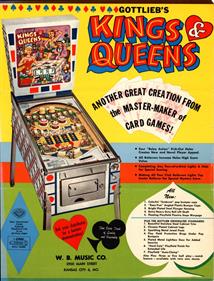
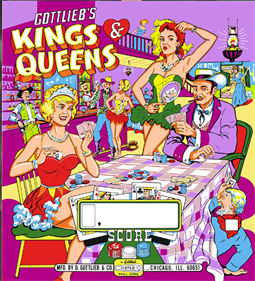
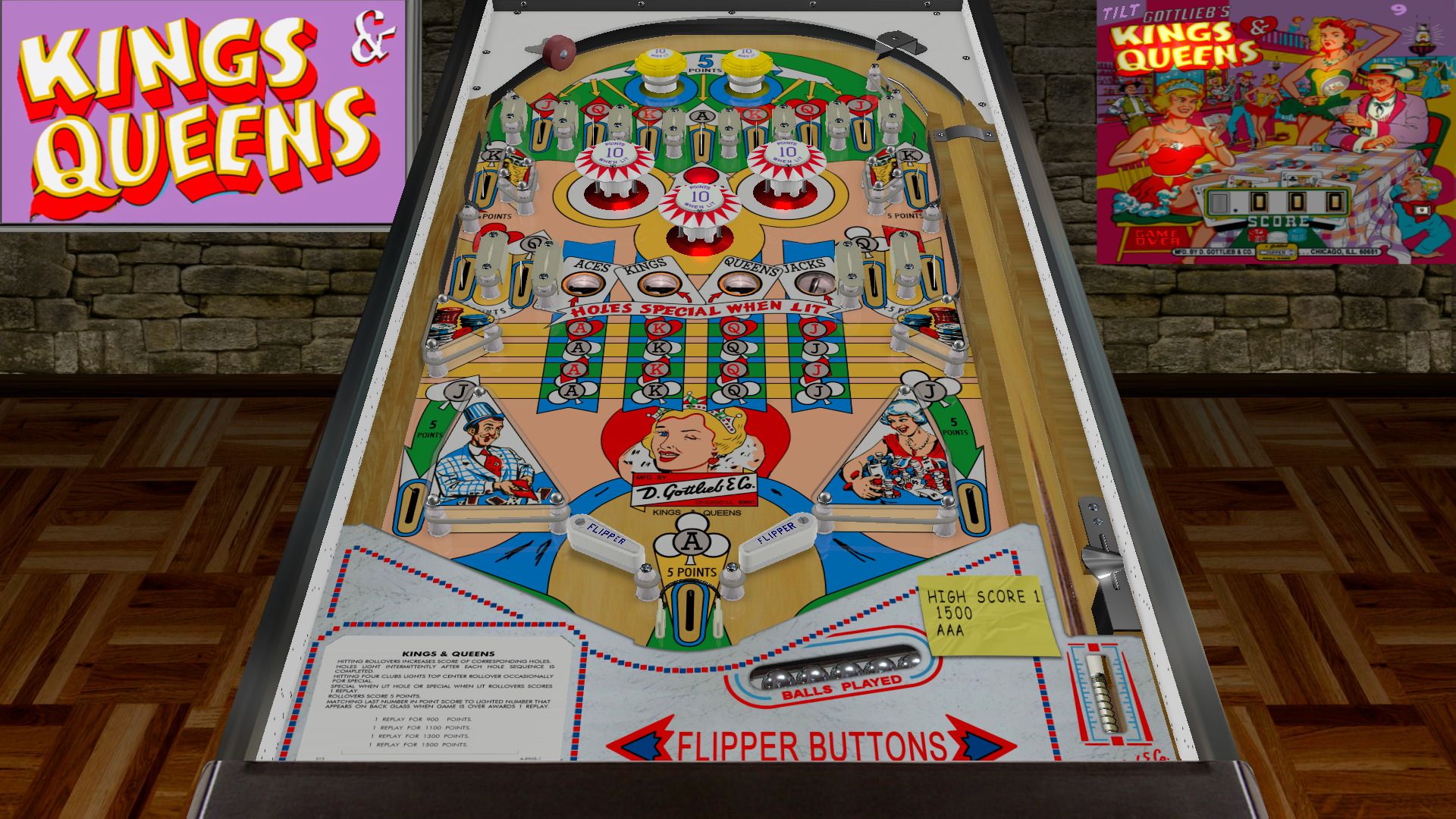
Kings and Queens is a very collectible Gottlieb wedgehead released in March 1965. Designed by Wayne Neyens, and featuring playing cards and gambling-themed artwork by Roy Parker, this single-player game is highly regarded as one of the standouts of pinball’s golden wedgehead era, and boasts a production run of 2,875 confirmed units.
The game tasks players with completing subsets of playing cards. To earn a "Special" replay, a player must collect all four suits (hearts, diamonds, clubs, and spades) across four specific card values: Aces, Kings, Queens, and Jacks. Achieving victory on Kings and Queens demands a high level of skill and precise nudging. While collecting the Queens is relatively accessible via top and middle rollovers, acquiring the remaining cards presents a high risk of a ball drain.
What elevates the gameplay of Kings and Queens is its innovative mechanical gimmick of four sequential, ball-transferring kick-out holes lined up across the center of the playfield. When a ball lands in the leftmost capture hole, the game use an incredibly smooth relay mechanism to transfer it to the adjacent pocket, marching it sequentially across the board before finally ejecting it back down near the flipper lanes. This distinctive chain-reaction layout provides satisfying tactile feedback rarely seen in mid-60s electro-mechanical designs.
Kings and Queens alsp holds a place in pop-culture history through its prominent appearance in the 1975 film adaptation of The Who's rock opera, Tommy. The machine is explicitly featured on-screen during the "Pinball Wizard" championship sequence, where it is played by the title character, portrayed by Roger Daltrey.