Overview
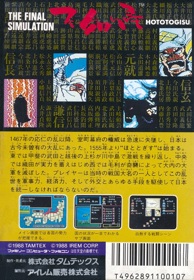
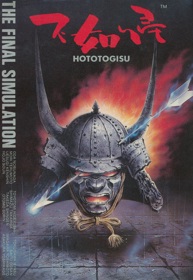
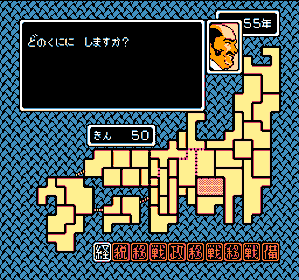
Despite what its title may suggest, Hototogisu's scope is not limited to the three Sengoku-period daimyō referred to in the Hototogisu children's poem (namely Nobunaga, Hideyoshi and Ieyasu). Instead, at the beginning in 1555, this game lets you choose to play as any of the 40 daimyō of the Sengoku period by selecting their territory as your starting region. Hototogisu is notable among the Sengoku-period Famicom strategy games for putting the most focus on the strategic side. A majority of this game's interactions take place on the strategic screen overviewing the whole historical Japan (meaning not including now-called Hokkaido).
Each year in the game is divided into 10 distinctive phases represented by the bar at the bottom: Administrative Action, Tax Collection, 1st Mobilization, 1st Battle, Political Action, 2nd Mobilization, 2nd Battle, 3rd Mobilization, 3rd Battle and Military Preparations. A unique feature of Hototogisu compared to its Famicom strategy peers is the vassalage system, in which you can negotiate with another daimyō to have him become your vassal or inversely, surrender to become his vassal yourself to avoid ending the campaign after a defeat. Becoming a vassal locks you out of the Battle phases.
Tactical battles consist of 2 types: field battle and siege, both taking place in an abstracted battle screen instead of a tactical map. In a field battle, you can choose a starting formation and change tactics as the battle auto resolves, or call for a retreat. In a siege, you have limited options as the defender - fight or surrender, but as the attacker, you have 3 main actions: send a messenger to the enemy daimyō to negotiate a surrender (and vassalize him), starve out the castle which takes the longest time but costs no casualty on your side, or full assault.
- Developers
- Tamtex
- Publishers
- Irem
- Platform
- Nintendo Entertainment System
- Genre
- Strategy
- Alternate Names
- No information available
- Wikipedia
- No information available
- Video
- No information available