
Overview
In the late 1980s, a small French studio, Legend Software, took up the development of the space adventure Nishiran. The creation of the game was marked by constant problems with publishers. That is why the project was originally intended for the Amiga, then for the Atari. A fully playable build already existed in 1990, but misfortunes haunted the authors relentlessly. At the end of 1991, new troubles were added to the fickleness of brands: Legend Software did not receive payments from the bankrupt publisher 16/32 Diffusion and found itself in debt.
Further work on the game was carried out by the two remaining enthusiasts: designer Manuel Pires and programmer Guillaume Lamonoca, for free, in the hope of completing the project. In a year and a half, they not only finalized the Atari version, but also made the game cross-platform, adding the ability to run Nishiran on PC.
By 1993, the project was completely ready and even offered a choice of French and English. For the next two years, a couple of developers who did not leave the sinking ship searched for a publisher to no avail. Finally, in 1995, a difficult decision was made about a shareware distribution model (the first thing a player sees after launching Nishiran is a request to send $10 to the authors' home email address). The game was never released in physical form, but in 1997, the tenacious French created a Windows version of their brainchild.
A few words about the genre. Oddly enough, most Internet reference books list "RPG" and "Dungeon Crawler" as such. The game has only a partially open world, a plot and more opportunities to make a mistake than in a shooter. There are no primary characteristics, skills, talents, inclinations, levels, experience and the list of the character as such. There are no relationships and dialogues with other characters, no moral choices (except for "throw a grenade or hit with a cannon"). Nishiran is a classic adventure/survive. Nishiran can only be called an "RPG" if you expand this concept beyond Subnautics. Most likely, two factors influenced the definition of the genre in reference books: the game has an eye view and it is not a shooter.
The adventure itself begins with a certain Kamashi, the regional manager of the star empire, summoning the protagonist to solve a problem with the planet Drenium. The emperor ruling there died, and the throne passed by inheritance to one of his two sons (called clever in the chronicles). The other son (called ambitious in the chronicles) fell into anger on this occasion, swore a lot and flew away from the planet (but promised to return). Some time after that, contact with Drenius was lost. The bosses of the empire began to suspect that the planet had been taken over by a dictator who was going to use its resources to take over the universe.
In connection with these events, it is decided to send one, but very talented in all respects scout (player) to the surface of the satellite Drenia. The previous expedition sent to the planet was destroyed directly at the landing site. It is assumed that it was discovered by the energy trail of the paratroopers' weapons, and in order to avoid a repetition of the annoying overlay, our character is sent into battle unarmed. In addition, the planet is surrounded by a huge force field, so to overcome it, the Space Marine capsule, andthe "nucleolus" is made miniature (obviously, the field has a large-mesh structure).
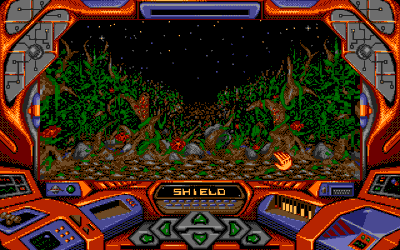
Nishiran is a turn-based and cell-by-cell game, with 90° rotations and a view from the eyes, or rather, through the windshield of the capsule, which elegantly turned into a robot after landing. The internal dashboard contains active controls. The most difficult puzzle, as in many similar games of the time, is the interface. Not everyone can figure out that the icon with an icon resembling "open folder" is used to turn the pages of the diary nested in the reading slot above - and to guess that the control buttons above the inventory slots do not refer to the capsule itself, but contain orders for the auxiliary droid (the existence of which the player should not suspect), only people with a good imagination can do.
The landscape of Drenium and its satellite is mainly of the corridor type: these are paths just one capsule wide and rare small glades-crossroads. You need to draw the map yourself, although the scheme of the first location can be found in the clue file attached to the game (level1_e.txt), As compensation for the lack of weapons,
the scout has a portable laboratory for molecular and nuclear analysis and fusion. Most of the objects found can first be examined (and their composition memorized), and then decomposed into atoms of several different types (they are depicted as multi-colored balls). From a certain number of the desired named particles, the desired equipment is synthesized according to the formula "2 gray + 2 blue + 3 brown". In addition, the fuel tank of the capsule can be used as a projectile at first.
It is not quite usual that the authors allowed everyone to take irreversible actions. For example, if the player does not notice the trap at the very beginning (and is blown up on it), he will not only destroy the already weak shield, but also lose the ability to pass the mine through the analyzer and disintegrator of his laboratory, and a little later - and synthesize fuel and grenades from its material. As a consolation, the potential rotosei is provided with as many as eight slots for saves.
Compared to modern survival games, Nishiran severely limits the time and resources of the survivor. A situation where a researcher can safely sip coffee with his legs stretched out on the dashboard of some "Cyclops" is impossible here. Unfortunately, such hardcore has to be compensated for by constant save/load, especially before traveling to remote areas: a few inappropriate warheads or minutes can turn into death.
To summarize, I will say that the authors were a little ahead of their time, creating a game in the actually non-existent genre of adventure / survival (I only think of Robinson's Requiem from 1994). This resulted in the difficulties of dialogues with publishers, and in the high requirements for the attentiveness of players and their ability to plan actions. Fans of the genre should get acquainted with the game at least from a historical point of view. Everyone else can take Nishiran as a challenge.
- Developers
- Guillaume Lamonoca, Manuel Pires
- Publishers
- Guillaume Lamonoca, Manuel Pires
- Platform
- MS-DOS
- Genre
- Adventure
- Alternate Names
- No information available
- Wikipedia
- No information available
- Video
- No information available