Overview
This is a hack for Final Fantasy Tactics Advance, an Strategy RPG made for the Game Boy, and part of a group of games that are connected by the setting of Ivalice, including not just the original Final Fantasy Tactics, but also games like Vagrant Story and Final Fantasy XII.
The aim is to overhaul the game play of FFTA. The intention is to make most of the content of the game engaging and useful in search for a more varied and smooth experience, in contrast to having a very select few number of elements dominating the game, and making it far less interesting for the author of this hack.
Among the changes made to the game, are these:
· Altering many game play aspects in search for a different type of balancing. This means taking away most of the weight on the formula used for normal attacks (used by the Fight Command and Abilities that use it) and making Abilities themselves be the main focus of the game, doing away with the concept of “one-shooting” everything in your path through the use of the usual suspects like Double Sword, or reducing the power from egregious elements to make a fairer game.
· Doing a major rework for Jobs. Stat growths, ability sets, and each one’s smaller aspects like Evasion and Status Defense to make as many of them interesting not just for their abilities, but to be actively used as the primary Job. Offensive stats and Speed are standardized, and is through equipment and their own quirks that the player can control if they prefer more power than Speed, or better survivability.
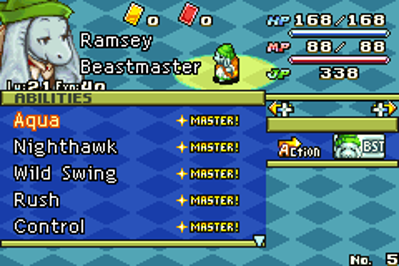
Some Jobs, like Morpher and Beastmaster received much bigger changes, and some shared Jobs, like Thief or Time Mage, differ in statistical growths and the Abilities they can use depending on the Tribe. On top of all that, each Job is capable of using four different types of weapons, which also expands the possibilities to set up and customize your units, when combined with a secondary Action Ability set.
· Very extensive changes to Abilities. Pretty much all now cost MP, and have their own Power values instead of using the weapon’s attack power (which is no longer used for any formula) for calculations. Damage, effects, range, number and targets and such was taken into account to attempt to make them fair all around. For example, single target abilities or melee ranged ones cost less MP than area of effect or long ranged ones, less intrusive Status Effects cost Less than those that cause Petrify or Frog, etc. Most damaging abilities now do elemental damage, and instead of the usual way of learning Abilities, now a JP System is used, where the player accumulates JP and can spend it to learn Abilities.
· Equipment has gone through a massive change-up. All gear has been grouped into three tiers tied to story progression (except accessories, which are equally useful throughout the entire game). Weapons also now provide Speed gains, based on the fact that Weapon types now represent, for the most part, some archetypes. For example, Swords and Rapiers are balanced in power and speed, Knives trade power for higher Speed, Knightswords and Instruments offer reduced power but boost your defensiveness, etc.
· All battles have been given a new coat of paint. Changes to their line ups, their equipment, changes to the AI as to what actions to choose (but mind you, it’s still mostly FFTA in that last regard). Enemies are better geared and know more abilities the more you progress through the game, with the vast majority of enemies having two ability sets as the norm, instead of very rarely like in vanilla.
Battles scale to your highest leveled unit, so there’s both no rush to grind, and no way to “overlevel” your enemies. Higher Levels means more MP for abilities and therefore more interesting game play, so it’s not like leveling is discouraged, it’s more about training all your units equally than having a couple of units with ridiculous levels destroying everything.
· Dispatch Quests have been reordered in order to make the game flow better. Now you get Quests that reward items for future dispatches, instead of mostly being the opposite, first getting those with requirements and several story missions later, getting the ones with the items you needed. With this change, not only the quest list won’t be bloated with missions you can’t do, it helps with the flow and pace of the game.
On top of that, to access the second story after reaching post game no longer needs to do the 300 numbered quests, so you can do it much sooner and even jump from optional quests to story quest as the player would do normally.
· Some tweaks to Laws. For example DMG2:Animals does no longer exist, Fight is no longer in the earliest set of rules, several of the punishments, like permanent statistical reductions were removed (but these can be brought back with an optional patch) and rulesets have been modified as the game progress. New Laws for elements that did not exist before were also added.
- Developers
- Maeson
- Publishers
- No information available
- Platform
- Nintendo Game Boy Advance
- Genre
- Strategy
- Alternate Names
- No information available
- Wikipedia
- No information available
- Video
- No information available