Overview
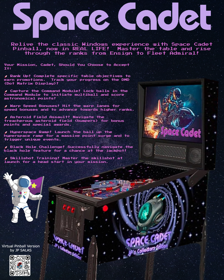
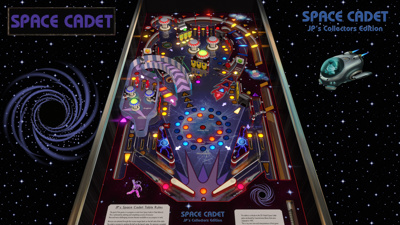
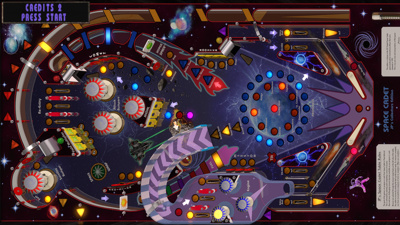
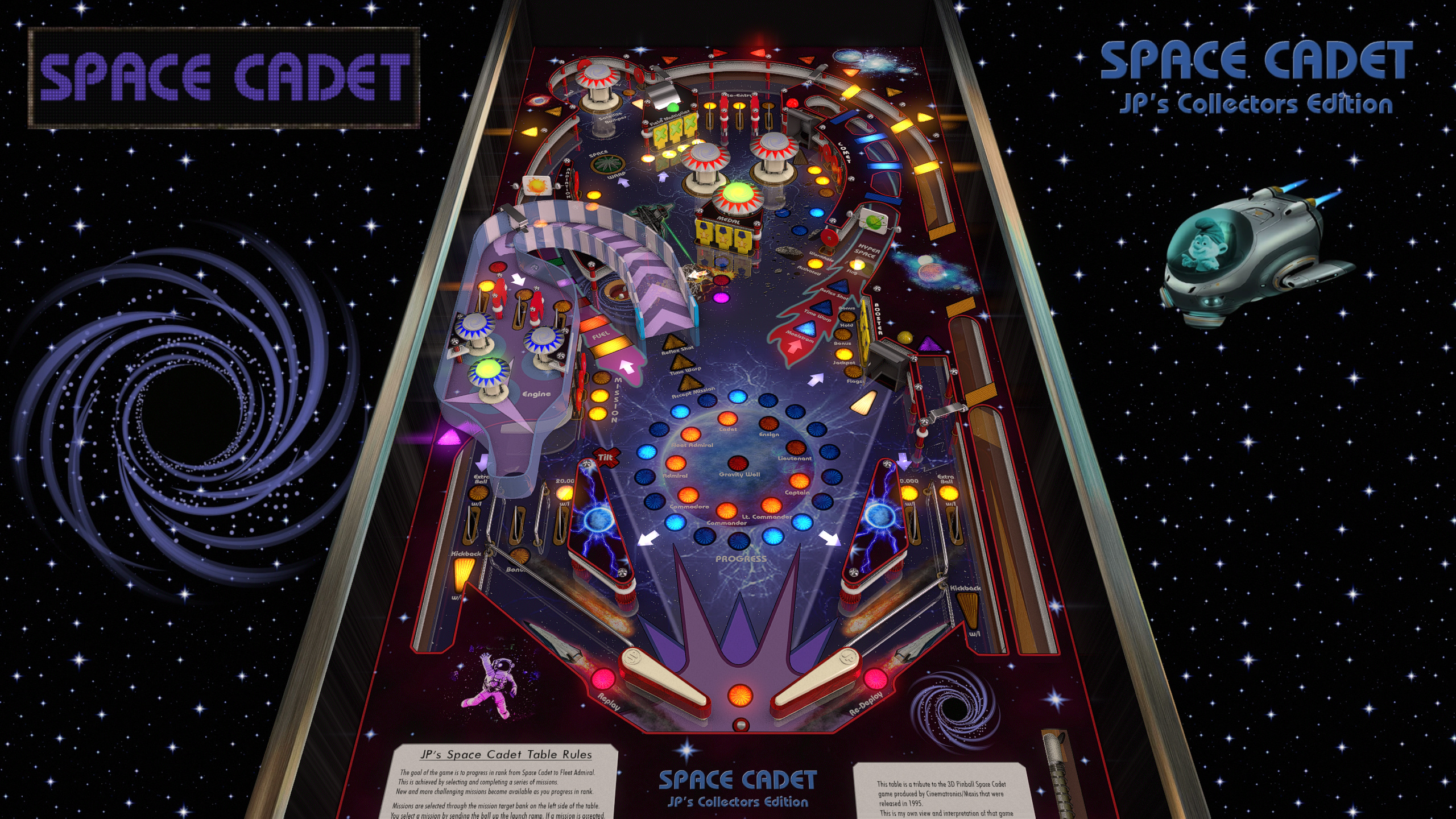
In the 1990s Space Cadet was the first experience of digital pinball for millions of people around the world. This is a modern recreation of Space Cadet with new music and more realistic ball physics released for Visual Pinball X in 2021 by prolific contributor JP Salas.
Originally, Space Cadet was released as part of "Full Tilt! Pinball" ("Pinball 95" in Europe), a 1995 pinball video game for Windows and Mac OS, developed by Cinematronics and published by Maxis. A limited version of the game with just the Space Cadet table was licensed to Microsoft for inclusion in Microsoft Plus! and later bundled in multiple versions of the Windows operating system with the name "3D Pinball for Windows – Space Cadet".
Space Cadet features the player as a member of a space fleet that completes missions to increase rank. Players can attain nine different ranks (listed from lowest to highest): Cadet, Ensign, Lieutenant, Captain, LT Commander, Commander, Commodore, Admiral, and Fleet Admiral. Players accept a mission by hitting "mission targets" which select which mission they will take, and by going up the "launch ramp".
Each mission has a set number of things for players to do, such as hitting the "attack bumpers" (which are a set of four bumpers at the top of the table) eight times (this is the "target practice" mission). Some missions involve a number of steps which must be completed in sequence. Missions end either by being completed, or by being aborted due to running out of "fuel", as indicated by the lights in the passage that passes under the launch ramp. The "fuel" lights go out one by one at a time interval, and can be re-lit by having the ball go over them, or all at once by going up the launch ramp again. Upon completing a mission, some of the blue lights in a circle in the middle of the table turn on. When all of the lights in the blue circle turn on, the player's rank increases, and a light in the orange circle turns on.
There are only a few minor differences between the gameplay of the two officially released versions of Space Cadet. The completion of a mission in the Maxis version results in a replay—actually a ball save, rather than a special—being awarded. In addition, hitting a wormhole that has the same color light locks the ball, which if done repeatedly activates the multi-ball round. This is not the case in 3D Pinball: completing a mission merely awards bonus points and hitting a wormhole in the above circumstances awards a replay. Also, the three yellow lights above the bumpers (both in the launch ramp and in the upper table zone) act differently: in 3D Pinball these are turned off if the ball passes on them while they are on. This is not the case in the original game, where they just remain activated.
The gameplay of the Visual Pinball X recreation is generally closer to the Maxis version than the Windows version, notablly including multiball.