Overview
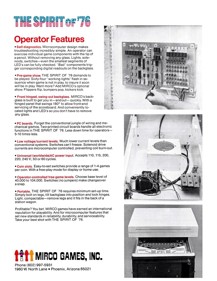
The Spirit of '76 (not to be confused with Gottlieb's "Spirit of 76") is generally believed to be the first commercially sold, solid-state pinball machine. It was released by Mirco Games, Inc. in October 1975. The game was based on the technology Dave Nutting Associates had created for Bally's unreleased 1974 prototype "Flicker". The firm licensed the technology to Mirco Games in 1975 for use in The Spirit of '76, since Bally was not initially interested in the system.
The table's layout is very similar to Gottlieb's 1972 "Flying Carpet", with the geometry adjusted, including moving the slingshots up to create in-lanes. At the top of the machine are four 1-9-7-6 rollovers. Below these are the S-P-I-R-I-T targets which can be hit by bouncing the ball from the 3 pop bumpers just below them. Further down the machine are two side-kickers, and just above the flippers are two triangular slingshots (which the manual for the game calls bumpers).
One change from electromechanical (EM) games is that solid state games could register all hits of targets, whereas EM games could only activate one relay at a time, so if multiple targets were hit in quick succession only the first one registered. Reliability was improved and operating costs were reduced by lowering the current to 3.5A at 5V, about 1/10th that on an EM machine. Also, in a 2-player game the machine could recall game conditions from one ball to the next, which was impossible on an EM machine.
However, despite these innovations, the game had a very limited production run. The playfield was considered so unattractive that very few were sold. The only other pinball games produced by Mirco Games were Lucky Draw and Space Fantasy, both cocktail models, in 1978.
- Developers
- Mirco Games
- Publishers
- Mirco Games
- Platform
- Pinball
- Genre
- Pinball
- Alternate Names
- No information available
- Video
- No information available