
Overview
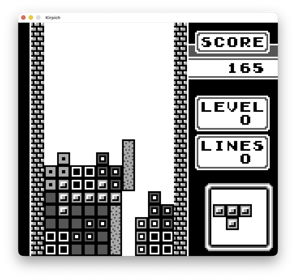
A native reimplementation of Tetris for the Game Boy (DMG), running as ordinary desktop software on Windows, macOS, and Linux. Kirpich is built on the Retro++ engine and reproduces the original cartridge's observable behavior — the same game, given the same inputs — without emulating the hardware and without translating the assembly. The player's own cartridge supplies the graphics and the sound.
Kirpich (кирпич) is Russian for "brick".
Features:
* The complete single-player game. A-Type and B-Type, every menu and screen, pause, game over, the end-of-round scoreboard, and the ending performance a highest-difficulty B-Type win earns.
* Both hidden endings. Clearing B-Type from beneath five rows of garbage launches the Buran; reaching 100,000 points in A-Type launches a rocket, one of three sized by the final score.
* A third game type. C-Type is a marathon played over a rising floor. A count of drops sits on the panel: every drop takes one off it, every line cleared puts one back, and when it reaches zero the whole stack shifts up a row and a fresh line of garbage arrives underneath. One line per drop is breaking even. It has its own screen, its own starting level, and its own table of high scores, and it sits behind a settings switch that is off by default — a new player meets the cartridge's own two modes first.
* The original audio. The cartridge's sound driver runs unmodified on the engine's emulated audio unit. Music and sound effects are produced by the original code, not recreated.
* Eighty color palettes, selectable in-game with a live preview — the hardware greyscale, the original handheld's green, the eight color schemes Windows 3.1 shipped in its Control Panel, and forty-eight that keep a real color in their darkest shade instead of bottoming out at black, many of them crossing from one hue to another on the way up. The darkest shade is what the well's walls and every locked block are drawn in, so it is most of what you look at.
* An optional ghost piece showing where the falling piece will land. Disabled by default, so the game plays exactly as the cartridge does until the player opts in.
* Persistent high scores. A qualifying round is ranked, named on the original letter-wheel entry screen, and kept across launches — the cartridge lost its tables at power-off.
* Attract mode. Left idle, the title screen plays the cartridge's two recorded demonstration rounds, alternating between them.
* Preserved behavior throughout, including the original's quirks: the reset chord (Start + Select + B + A) keeps the high-score tables and clears everything else, a multi-line clear duplicates its top row, and the unused stereo panning data remains unused. These are reproduced deliberately rather than corrected; see docs/DESIGN.md.
* A settings screen for fullscreen (Alt+Enter / Cmd+Enter also toggles it), window scaling, the palette selection, the ghost piece, the extra game types, a fixes screen that offers the cartridge's own quirks back — off by default, fidelity until you ask otherwise — and a confirmed high-score reset. Settings persist alongside the score tables and apply before the window opens.
- Developers
- etroimcasso
- Publishers
- No information available
- Platform
- Windows
- Genre
- Puzzle
- Alternate Names
- No information available
- Wikipedia
- No information available
- Video
- No information available